
Assessment & Certification at GoodBoy
The Australian Companion Dog Skills (ACDS) framework is a structured, assessment-based certification system designed to evaluate real-world companion dog skills across developmental stages and environments.
The framework focuses on:
practical handling skills
emotional regulation and recovery
safe, appropriate behaviour in community settings
GoodBoy Animal Training participates in this framework as an approved evaluator, offering assessment and certification for dogs who meet the published criteria.
Important:
Training participation does not guarantee certification.
Certification is awarded only when assessment criteria are independently met.
How Certification Works
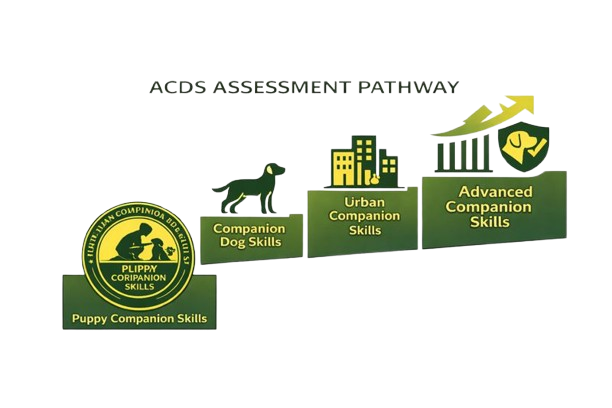
Train → Prepare → Assess → Certify
Dogs may be assessed regardless of where they were trained
Assessments are criteria-based and conducted by an evaluator
No food reinforcement is used during formal testing
Long lines may be used where required for safety or venue compliance
Prerequisite Requirements
To ensure consistency and integrity within the Australian Companion Dog Skills framework, dogs must have successfully passed Companion Dog Skills (Level 2) prior to undertaking assessment for Urban Companion Dog Skills (Level 3) or Advanced Companion Dog Skills (Level 4).
Level 1 — Puppy Companion Skills
(6 months of age and under | Group class required)
A developmental certification recognising early social exposure, handling tolerance, calm behaviour, and foundational skills in a structured group environment.
Assessment Checkpoints
All checkpoints must be met
Handling & body comfort
Allows gentle handling (collar/harness touch, brief body and paw handling)
May show startle but recovers within a reasonable time
Engagement & movement
Moves with handler on lead without frantic pulling
Can follow handler direction changes within a group class
Foundational positions
Sit on cue
Drop on cue
(Single cue; age-appropriate latency accepted)
Recall
Returns to handler from 3 metres
Performed on a long line
One verbal cue
Puppy may hesitate briefly but must complete the recall
Settle
Can settle beside handler for a short period while activity occurs nearby
Social exposure
Appropriate behaviour around people and other puppies
No sustained barking, lunging, or panic behaviour
Level 2 — Companion Dog Skills
(General certification | Group recommended, individual available)
The core companion dog certification assessing basic manners, lead skills, and behavioural stability in low-to-moderate distraction environments.
Assessment Checkpoints
All checkpoints must be met
Urban lead skills
Maintains controlled lead walking in busier environments
Navigates tighter spaces without escalating behaviour
Public settling
Settles beside handler in a public setting for a defined period
Passing skills
Passes people, dogs, prams, bikes, and movement calmly
No sustained reactivity that compromises safety
Recall
Returns to handler from 10–15 metres
Long line or controlled open space permitted
One verbal cue
Dog must disengage from mild environmental distractions
Impulse control
Leaves dropped food or items when cued
Waits appropriately at thresholds or curbs
Environmental stability
Appropriate responses to common urban stimuli
Startle allowed; failure to recover is not
Supervised separation
Remains appropriate with evaluator while handler steps away briefly
Level 3 — Urban Companion Dog Skills
(Community / public environments | Group or individual)
Prerequisite: Companion Dog Skills (Level 2)
Assesses behaviour and handling in real-world environments with increased noise, movement, and proximity.
Assessment Checkpoints
All checkpoints must be met
Urban lead skills
Maintains controlled lead walking in busier environments
Navigates tighter spaces without escalating behaviour
Public settling
Settles beside handler in a public setting for a defined period
Passing skills
Passes people, dogs, prams, bikes, and movement calmly
No sustained reactivity that compromises safety
Recall
Returns to handler from 10–15 metres
Long line or controlled open space permitted
One verbal cue
Dog must disengage from mild environmental distractions
Impulse control
Leaves dropped food or items when cued
Waits appropriately at thresholds or curbs
Environmental stability
Appropriate responses to common urban stimuli
Startle allowed; failure to recover is not
Supervised separation
Remains appropriate with evaluator while handler steps away briefly
Level 4 — Advanced Companion Dog Skills
(Highest level | Group or individual)
Prerequisite: Companion Dog Skills (Level 2)
Demonstrates advanced reliability, emotional regulation, and handler-dog teamwork in complex or high-distraction environments.
Assessment Checkpoints
All checkpoints must be met
Advanced lead handling
Consistent loose lead walking in high-distraction settings
Smooth response to handler pace and direction changes
Duration & reliability
Strong Stay with increased duration and/or distraction
Calm Settle in challenging environments
High-level neutrality
Maintains functional neutrality around people and dogs at closer proximity
Minimal fixation with rapid recovery if arousal occurs
Recall
Returns to handler from 15–20 metres
One verbal cue
Dog must demonstrate commitment to the recall despite moderate to high distraction
Brief hesitation acceptable; failure to re-engage is not
Advanced impulse control
Leaves high-value distractions on cue
Demonstrates controlled waiting at doors, gates, and narrow passages
Real-world resilience
Moves through a sequence of environmental challenges
Maintains composure, responsiveness, and safe behaviour throughout
Training & Assessment at GoodBoy
Group Classes (Recommended)
Group training supports neutrality, controlled exposure, and real-world reliability — particularly valuable for Companion and Urban preparation.
Individual Lessons (Available)
Individual sessions are available for targeted skill development and assessment preparation where appropriate.
Note: Puppy Companion Skills assessment must be completed in a group class environment..
Upon successful completion of an Australian Companion Dog Skills assessment at GoodBoy, handlers will receive an official ACDS ribbon recognising the level achieved.
Certified teams are also eligible to register their assessment with Australian Companion Dog Skills to receive an official ACDS certificate.
For full details on certification, levels, and evaluator standards, visit
AUCDS.org